
STATE OF THE NATION
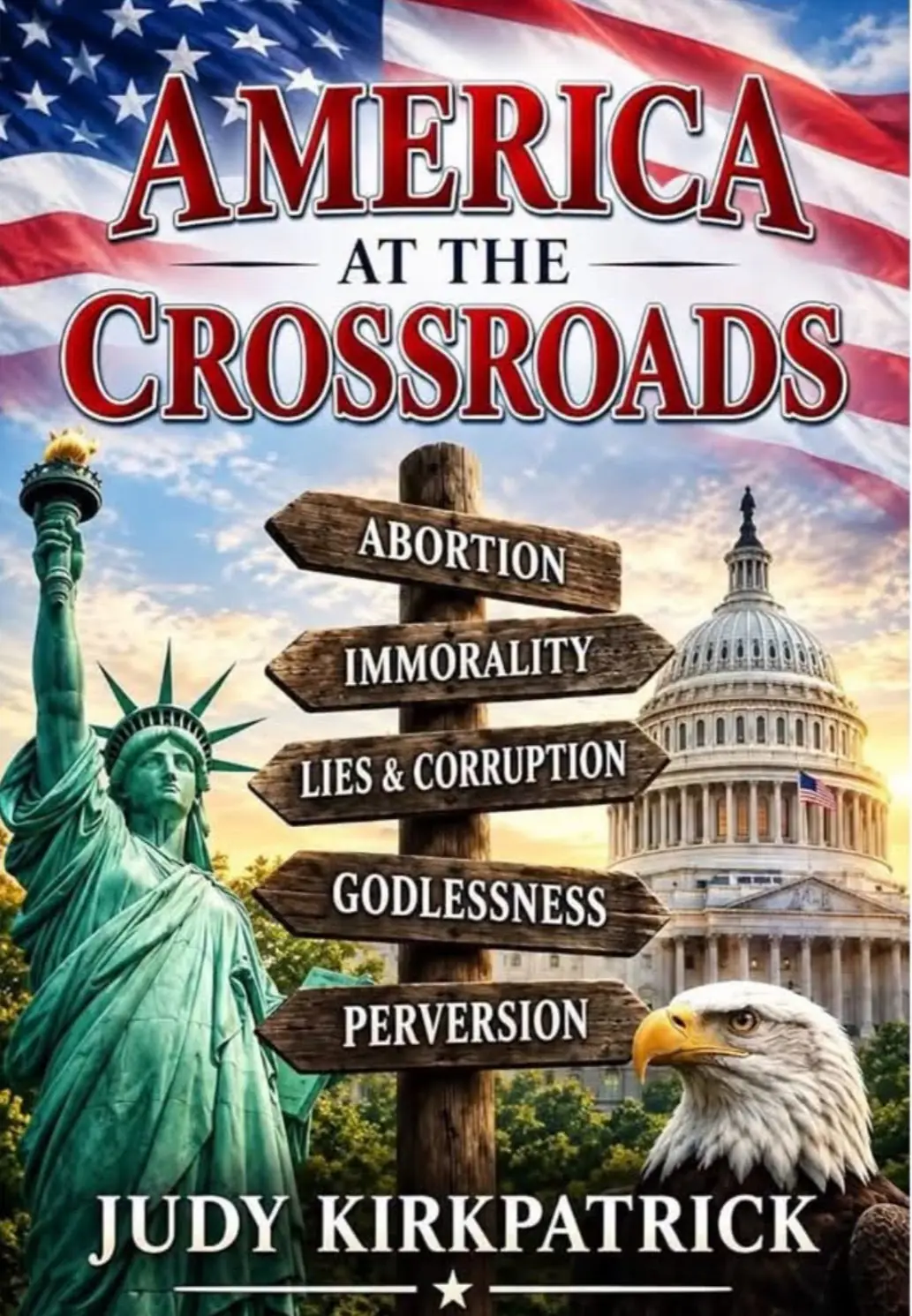
America at the Crossroads
A Call for the Church to Awaken
By Judy Kirkpatrick
Good morning, and thank you for allowing me the opportunity to share what has been weighing so heavily upon my heart.
I want to begin by asking you a question.
Do you recognize the America we are living in today?
I don't mean the mountains, the rivers, the beautiful countryside, or the familiar streets of our hometowns.
I mean the values, the priorities, the respect for authority, the strength of our families, and the place that God once held in so many of our communities.
Do you recognize that America?
I have asked myself that question many times.
It was one of the reasons I wrote my book, America at the Crossroads.
I wrote it because I love my country. I love the freedoms we enjoy, the sacrifices made by generations before us, and the opportunities America has provided.
But I am deeply concerned about the direction we are traveling.
And I believe every Christian should be concerned enough to ask some difficult questions.
What kind of nation are we becoming?
What kind of world are we leaving our children and grandchildren?
And perhaps most importantly, what responsibility does the church have in all of this?
I am not here to tell you that everything was perfect when I was growing up. It certainly wasn't.
But I remember a time when common sense, dignity, personal responsibility, and biblical morality were openly valued.
I remember when a person's word meant something.
When children were taught to respect their parents and teachers.
When neighbors helped neighbors.
When families prayed together.
And when many churches were unafraid to preach the whole counsel of God's Word.
Somewhere along the way, much of that seems to have changed.
The question is, are we going to spend our time simply complaining about those changes, or are we willing to do something that makes a difference?
Because I believe America is standing at a crossroads.
And I believe the church has a responsibility to help point the way.
1. WHEN THE CHURCH LOSES ITS VOICE
Some of you remember the old-fashioned tent revivals.
You remember the wooden benches, the singing, the invitations to come forward, and the preachers who were not afraid to talk about sin, repentance, heaven, and hell.
Those revival meetings sometimes lasted two weeks.
Services might go on for three or four hours.
People came expecting to hear from God.
They came seeking forgiveness, spiritual renewal, and a changed life.
Today, many revival meetings have been reduced to a few evenings, and some churches have abandoned them altogether.
Now, I realize that the length of a meeting does not determine its spiritual value.
But I do wonder whether, in our effort to make church convenient, we have sometimes lost our sense of urgency.
Have we become more concerned about getting people out of church on time than about whether their hearts are right with God?
Have we become so afraid of offending people that we are unwilling to confront sin?
Have we replaced biblical conviction with messages designed primarily to make people feel comfortable?
Second Timothy 4:3–4 warns:
"For the time will come when they will not endure sound doctrine; but after their own lusts shall they heap to themselves teachers, having itching ears; And they shall turn away their ears from the truth, and shall be turned unto fables."
Those words should cause every Christian to examine the condition of the church.
There is nothing wrong with encouraging people.
There is nothing wrong with preaching about God's love, mercy, and forgiveness.
But the Gospel is more than encouragement.
The Gospel calls us to repentance.
Jesus did not come merely to make people feel better about their circumstances.
He came to save sinners.
And salvation requires us to recognize our need for a Savior.
We must be careful not to confuse welcoming people into the church with approving everything the world teaches.
The church should be a place where everyone can hear the Gospel.
But it must also remain a place where biblical truth is proclaimed.
We cannot preach a message of salvation while refusing to acknowledge what we need to be saved from.
Yet there is another danger we must recognize.
We can become so eager to identify the sins of society that we overlook the sins within our own lives.
Pride is sin.
Dishonesty is sin.
Greed is sin.
Cruelty is sin.
Hatred is sin.
And hypocrisy is sin.
If we expect the world to take our message seriously, we must demonstrate that we are willing to live by the same standards we proclaim.
First Peter 4:17 reminds us that judgment begins at the house of God.
Before we demand that America return to God, perhaps we should ask whether the church itself needs to return to Him.
A nation cannot experience spiritual renewal through a church that has become spiritually indifferent.
2. HAVE WE FORGOTTEN WHAT REVIVAL REALLY MEANS?
When we speak about revival, we often think of special services, guest speakers, music, and altar calls.
But revival is not a program.
It is not something we can manufacture by putting dates on a calendar.
Revival begins when people become genuinely concerned about their relationship with God.
It begins when we stop making excuses for our own disobedience.
It begins when we are willing to forgive those who have hurt us.
It begins when we stop treating prayer as a last resort.
And it begins when God's Word becomes more important than the opinions of the world.
Second Chronicles 7:14 says:
"If my people, which are called by my name, shall humble themselves, and pray, and seek my face, and turn from their wicked ways; then will I hear from heaven, and will forgive their sin, and will heal their land."
Those words were originally spoken to Israel, and we should respect their biblical context.
But the principles of humility, prayer, repentance, and seeking God remain important for Christians today.
Notice that the passage begins with God's people.
Not the government.
Not the news media.
Not our neighbors.
God's people.
How often do we pray for God to change our nation while resisting the changes He wants to make in us?
We ask Him to restore our families, but are we investing time in them?
We ask Him to protect our children, but are we teaching them Scripture?
We ask Him to strengthen our churches, but are we willing to serve?
We ask Him to heal division, but are we willing to forgive?
Revival requires more than recognizing that something is wrong.
It requires a willingness to change.
And I believe that is where the church must begin.
3. THE BATTLE FOR OUR CHILDREN
One of my greatest concerns about the future of America involves our children.
I look at the world they are growing up in, and I realize how different it is from the world many of us experienced.
Children today are surrounded by information.
They have access to television, social media, electronic devices, movies, books, games, and countless voices competing for their attention.
Some of those influences can be educational and beneficial.
Others expose young people to material they may not be emotionally or spiritually prepared to understand.
And often that exposure occurs long before parents realize what their children have encountered.
I believe we need to ask ourselves a serious question.
Who is shaping the minds and hearts of our children?
Is it their parents?
Their grandparents?
Their churches?
Or is it whoever happens to be speaking the loudest through a screen?
In recent years, Americans have engaged in intense debates about parental rights, school curriculum, sexually explicit materials, gender identity, and age-appropriate instruction.
Christians hold different opinions about how some of these issues should be addressed.
But I believe parents have a fundamental responsibility to know what their children are learning and to remain actively involved in their education.
Parents should be able to examine instructional materials.
They should be able to ask respectful questions.
They should know what programs and activities their children are participating in.
And they should be prepared to discuss difficult subjects with wisdom, honesty, and compassion.
At the same time, we must remember that every child deserves dignity, safety, and love.
Children who are confused, frightened, struggling with their identity, or experiencing emotional difficulties do not need ridicule.
They need caring adults who will listen, protect them, and guide them responsibly.
As Christians, we should never allow our convictions to become an excuse for cruelty.
Jesus demonstrated both truth and compassion.
We must do the same.
Deuteronomy 6:6–7 teaches:
"And these words, which I command thee this day, shall be in thine heart: And thou shalt teach them diligently unto thy children..."
That is a responsibility the church cannot afford to neglect.
Parents and grandparents, we must become more involved.
Know what your children are reading.
Know what they are watching.
Know who is influencing them.
Talk with them.
Pray with them.
Answer their questions.
And most importantly, live the kind of Christian life you want them to imitate.
Because children may forget many of the things we tell them.
But they often remember what they see us do.
4. WHAT ARE WE TEACHING THE NEXT GENERATION?
My concern for young people is one reason I began writing books for children and teenagers.
I wanted to create stories that would capture their imaginations while teaching the importance of faith, honesty, courage, kindness, forgiveness, and responsibility.
I wanted young readers to discover that doing what is right sometimes requires standing alone.
That integrity matters even when no one is watching.
And that ordinary young people can accomplish extraordinary things when they are willing to serve others.
I have become increasingly concerned about the messages children encounter through entertainment and literature.
Some stories introduce spiritual practices or beliefs that conflict with biblical Christianity.
Other stories may blur the distinction between faith, superstition, fantasy, and occult themes.
Christians may disagree about how to interpret particular books or fictional stories.
But I believe parents should be willing to examine the material and discuss it with their children.
We should not simply assume that because a book is popular, it is suitable for every child.
Nor should we assume that a book labeled Christian automatically teaches sound biblical doctrine.
First John 4:1 instructs believers to test the spirits rather than believe every spiritual claim.
That principle of discernment is important.
We need to teach our children to recognize the difference between biblical truth and ideas that merely sound spiritual.
We need to help them understand that not every supernatural claim comes from God.
But discernment is not the same as fear.
Our children should be equipped to think carefully, ask questions, understand Scripture, and make wise decisions.
We cannot protect them forever by hiding every difficult subject.
We must prepare them to face a complicated world with strong character and a well-grounded faith.
And that preparation begins long before they leave home.
If we do not intentionally teach our children what we believe, we cannot be surprised when someone else teaches them what to believe.
5. THE SPIRITUAL BATTLE WE MUST UNDERSTAND
Ephesians 6:12 says:
"For we wrestle not against flesh and blood, but against principalities, against powers, against the rulers of the darkness of this world, against spiritual wickedness in high places."
That is a powerful reminder.
Our ultimate spiritual struggle is not against the people living next door.
It is not against a child who disagrees with us.
It is not against every person who belongs to another religion.
And it is not against everyone who votes differently.
Our battle is spiritual.
The Bible teaches that Satan is a deceiver.
It warns believers against temptation, false teaching, pride, and spiritual compromise.
But Scripture also tells us how to stand.
Ephesians 6 describes the armor of God.
Truth.
Righteousness.
The preparation of the Gospel of peace.
Faith.
Salvation.
The Word of God.
And prayer.
Notice what is missing from that list.
Hatred.
Cruelty.
Bitterness.
Revenge.
Those are not the weapons God has given His people.
We should take seriously the biblical warnings about occult practices, false worship, and spiritual deception.
But we should also remember that our mission is to lead people toward Christ, not drive them away through hostility.
We must learn to distinguish between opposing an idea and attacking a person.
A Christian can firmly reject a belief while still treating the person who holds it with kindness.
In fact, that is part of our witness.
If our words proclaim the love of Christ but our actions communicate contempt, what message are we really sending?
The world should recognize Christians by their faithfulness to truth and by the love that accompanies it.
6. THE CONDITION OF OUR FAMILIES
When we talk about the problems facing America, it is easy to focus on Washington, schools, television, or social media.
But I believe we also need to examine what is happening inside our homes.
Families are under tremendous pressure.
Parents are working long hours.
Many households are struggling financially.
Children face social pressures that previous generations could scarcely have imagined.
Technology has changed how families communicate.
It is possible for several people to sit in the same room, each looking at a different screen, without having a meaningful conversation.
And sometimes the people who live under the same roof barely know what is happening in one another's lives.
That should concern us.
Children need more than food, clothing, and a place to sleep.
They need attention.
They need boundaries.
They need encouragement.
They need correction when they are wrong and reassurance when they are struggling.
They need adults who will teach them how to handle disappointment, control anger, show respect, and take responsibility for their decisions.
And they need to know that love does not disappear when they make mistakes.
Proverbs 22:6 tells us:
"Train up a child in the way he should go: and when he is old, he will not depart from it."
This verse emphasizes the importance of early instruction. It should not be used to blame faithful parents for every decision an adult child eventually makes.
But it reminds us that the lessons of childhood can have a lasting influence.
We must stop assuming that someone else will teach our children everything they need to know.
The school cannot replace the family.
The pastor cannot replace the parent.
And one hour of Sunday school cannot replace a week of spiritual neglect.
Our children need to see faith demonstrated in everyday life.
They need to see us pray when we are worried.
They need to see us apologize when we are wrong.
They need to see us forgive when we have been hurt.
And they need to see that following Christ changes the way we live.
7. RELIGIOUS FREEDOM IS WORTH DEFENDING
One of America's greatest blessings is the freedom to worship according to our convictions.
We can gather in churches.
We can own Bibles.
We can preach, teach, sing, pray, and share our faith.
Those freedoms are precious.
And they should never be taken for granted.
In other parts of the world, Christians have suffered imprisonment, violence, and death because of their faith.
In 2015, the world witnessed the brutal murder of 21 Egyptian Christians in Libya by ISIS.
Their deaths were a heartbreaking reminder that religious persecution remains a reality.
Christian communities in places such as Nigeria have also suffered devastating attacks and violence.
We should pray for persecuted believers and support efforts to protect innocent lives.
But religious freedom is not something we can claim only for ourselves.
The same constitutional principles that protect our right to worship also protect the rights of people who follow other religions.
We do not have to agree with their beliefs to defend their freedom of conscience.
We should stand firmly against terrorism, religious coercion, violence, and abuse.
But we must not confuse violent extremists with every member of a religious community.
Jesus commanded us to love our neighbors.
That command does not end when our neighbors disagree with us.
Our faith should give us the courage to defend our beliefs without denying the humanity of others.
And we should remember that the Gospel has never depended upon government power to change a human heart.
The Gospel changes lives through the power of God.
8. WHEN GOOD IS CALLED EVIL AND EVIL IS CALLED GOOD
Isaiah 5:20 declares:
"Woe unto them that call evil good, and good evil; that put darkness for light, and light for darkness..."
That verse has been on my mind as I consider the moral confusion of our times.
We live in a society where people often disagree about fundamental questions of right and wrong.
Things once widely accepted are questioned.
Practices once discouraged are defended.
And many people seem uncertain whether moral truth exists at all.
But Christians believe that truth is not simply determined by popularity.
We believe God's Word provides a foundation for moral understanding.
That does not mean every cultural tradition from the past was righteous.
History reminds us that Christians, too, have sometimes defended practices that were unjust.
Therefore, we must examine our beliefs carefully and allow Scripture to correct us as well as guide us.
We should not simply ask whether something is traditional.
We should ask whether it is biblical.
We should not assume that every new idea is wrong.
Nor should we assume that every new idea represents progress.
We must learn to evaluate ideas through prayer, careful study, and sound judgment.
Romans 12:2 instructs believers not to be conformed to this world but to be transformed by the renewing of their minds.
That is a call to spiritual discernment.
It means we should not allow public opinion, political pressure, or personal convenience to become the final authority over our lives.
But it also means we must be willing to examine our own assumptions.
Truth should matter more than winning an argument.
And righteousness should matter more than defending a political side.
9. THE DANGER OF A SILENT CHURCH
Ezekiel 33 describes the responsibility of a watchman.
When danger approached, the watchman was expected to sound the warning.
If he remained silent, others could suffer because they had not been warned.
I believe that passage offers an important lesson about responsibility.
There are times when Christians must speak.
When children are being harmed, we should speak.
When families need help, we should respond.
When injustice occurs, we should not look away.
When religious freedom is threatened, we should defend it.
And when biblical truth is distorted, we should be prepared to explain what Scripture actually teaches.
But a watchman must also be trustworthy.
If he sounds an alarm over every rumor, people eventually stop listening.
If he exaggerates a danger, he damages his credibility.
If he speaks without understanding the facts, he may harm the very people he intends to protect.
That is why Christian courage must be accompanied by Christian integrity.
We should verify information before repeating it.
We should distinguish facts from opinions.
We should avoid spreading accusations we cannot support.
And we should never allow political anger to become more important than truth.
The church must not be silent.
But when we speak, we must speak responsibly.
A courageous Christian witness is not merely loud. It is truthful, faithful, and worthy of trust.
10. CHRISTIANS AND THE RESPONSIBILITY OF CITIZENSHIP
We have been blessed to live in a nation where ordinary citizens can participate in the political process.
We can vote.
We can communicate with elected officials.
We can examine public policies.
We can attend meetings, express concerns, and work to improve our communities.
These are privileges many people around the world do not enjoy.
And I believe Christians should approach them with seriousness and responsibility.
There are important issues facing our country.
The protection of children.
The strength of families.
Religious liberty.
Public safety.
Economic stability.
Education.
The treatment of the vulnerable.
And the integrity of those entrusted with public office.
These matters deserve thoughtful consideration.
I am not here to tell anyone which political party deserves their loyalty.
I am asking something more fundamental.
Are we taking the time to become informed?
Are we willing to examine the actual positions and records of candidates?
Are we prepared to question leaders even when they belong to the political party we generally support?
And are we willing to reject dishonesty even when it appears to benefit our preferred side?
Christian integrity cannot be conditional.
We cannot condemn dishonesty in one political party and excuse it in another.
We cannot demand accountability from our opponents while refusing to hold our own leaders accountable.
Micah 6:8 reminds us that God requires us to do justly, love mercy, and walk humbly with Him.
Those principles should influence the way we approach every responsibility, including citizenship.
But we must remember something else.
Our hope is not in a political party, a president, or an election. Our hope is in Jesus Christ.
Governments change.
Leaders come and go.
Political movements rise and fall.
But the Kingdom of God is not dependent upon an election result.
We should be responsible citizens without allowing politics to become an idol.
And we should never forget that our first allegiance is to Christ.
11. WE NEED MORE THAN COMPLAINTS — WE NEED ACTION
I have spent much of this message talking about concerns.
But concern without action accomplishes very little.
We can talk about the decline of family values.
We can talk about the problems facing young people.
We can talk about the need for stronger churches.
But eventually we must ask ourselves:
What are we willing to do?
There may be a child in our congregation who needs encouragement.
There may be a single parent who is overwhelmed.
There may be a senior citizen who has not received a visitor in weeks.
There may be a teenager struggling with loneliness who desperately needs a trustworthy adult to listen.
There may be a family in our community wondering where their next meal will come from.
What if our churches became known not only for what we oppose, but also for the good we accomplish?
What if every congregation developed meaningful opportunities for young people to serve?
What if teenagers helped plant community gardens and distribute fresh vegetables to seniors?
What if church members volunteered to tutor struggling students?
What if families made a commitment to spend time together in prayer and Bible study?
What if we reached out to neighbors who had stopped attending church?
What if we became as passionate about helping hurting people as we are about discussing the problems of society?
James 2:17 tells us:
"Even so faith, if it hath not works, is dead, being alone."
Our faith should produce action.
It should move us beyond the sanctuary and into the needs of the community.
We do not have to wait for a national movement.
We can begin right here.
In our own church.
In our own neighborhood.
In our own families.
12. WHAT WILL OUR CHILDREN INHERIT?
I want you to imagine a scene many years from now.
Our children and grandchildren are gathered together.
Perhaps they are looking through old photographs.
Perhaps they are reading family letters or remembering stories told by their grandparents.
And someone asks:
"What was America like when they were growing up?"
What will the answer be?
Will they remember us as a generation that had every opportunity to make a difference but remained silent?
Will they say we spent our time arguing while families struggled and communities suffered?
Will they remember a church that was more concerned about protecting its comfort than reaching the lost?
Or will they remember Christians who were willing to stand firm in their faith, help their neighbors, strengthen their families, and serve their communities?
Will they remember grandparents who prayed with them?
Parents who taught them right from wrong?
Church members who encouraged them when they were struggling?
And adults who demonstrated that following Jesus was not merely something they talked about on Sunday?
That is the legacy I want us to leave.
A legacy of faith.
A legacy of courage.
A legacy of truth.
And a legacy of love.
The decisions we make today will influence the lives of people we may never meet.
That is a tremendous responsibility.
But it is also a tremendous opportunity.
13. THE CHURCH MUST AWAKEN
I want to return to the question I asked at the beginning.
Do you recognize the America we are living in today?
Perhaps the more important question is this:
Would the early church recognize the commitment of Christians living in America today?
Would they recognize our devotion to prayer?
Our willingness to sacrifice?
Our concern for the lost?
Our commitment to biblical truth?
Our love for one another?
The early Christians did not have beautiful sanctuaries, television ministries, or modern technology.
They did not have the political influence or material resources available to many churches today.
But they had something that changed the world.
They had a living faith.
They believed the Gospel was worth proclaiming.
They believed Jesus Christ was worth following.
And they understood that discipleship sometimes required sacrifice.
Today, we have more resources than any generation before us.
But resources alone cannot produce revival.
Programs cannot replace prayer.
Entertainment cannot replace worship.
Popularity cannot replace truth.
And religious activity cannot replace a genuine relationship with Jesus Christ.
Revelation 2 records a warning to the church at Ephesus.
The believers were commended for their labor and perseverance.
Yet the Lord said they had left their first love.
What a sobering thought.
A church can be busy and still lose sight of what matters most.
We can organize events, maintain buildings, and conduct meetings while neglecting the love and devotion that should motivate everything we do.
Could that be happening among us?
Have we become so accustomed to church that we have forgotten the wonder of salvation?
Have we become so comfortable with religious routines that we no longer expect God to transform lives?
Have we become so focused on the failures of society that we have neglected our own spiritual condition?
Church, we need more than another program.
We need a renewed commitment to Christ.
We need Christians who will pray when no one is watching.
Who will study Scripture when no one is reminding them.
Who will serve when there is no recognition.
Who will stand for truth when it is unpopular.
And who will demonstrate the love of Jesus even toward those who disagree with them.
That is the kind of church that can make a lasting difference.
14. A FINAL CHALLENGE: IF NOT US, WHO?
As I bring this message to a close, I want to challenge each of us personally.
Not our neighbors.
Not our politicians.
Not the people sitting on the other side of the sanctuary.
Ourselves.
What am I doing to strengthen my family?
What am I doing to encourage the next generation?
What am I doing to share the Gospel?
What am I doing to support my church?
And what am I doing to demonstrate the character of Christ in my everyday life?
It is easy to recognize what is wrong with the world.
It is much harder to recognize what needs to change within ourselves.
But that is where spiritual renewal begins.
Jesus said in Matthew 5:13–14 that His followers are the salt of the earth and the light of the world.
Salt has an influence.
Light makes a difference.
But neither accomplishes its purpose by remaining separate from the place where it is needed.
We are not called to hide from the world.
We are called to live faithfully within it.
To proclaim truth.
To practice righteousness.
To show mercy.
To defend the vulnerable.
To teach our children.
To strengthen our communities.
And to point people toward Jesus Christ.
I believe America is standing at a crossroads.
But I also believe every Christian faces a personal crossroads.
Will we choose comfort or commitment?
Silence or courage?
Indifference or responsibility?
Bitterness or forgiveness?
Fear or faith?
Those choices are made every day.
In our conversations.
In our homes.
In our churches.
And in the way we respond to the needs of others.
We cannot change yesterday.
We cannot guarantee what tomorrow will bring.
But we can determine how faithfully we will live today.
And today, I believe God is calling His people to renewed commitment.
Not merely to preserving memories of a better past.
But to building a faithful future.
Not merely to criticizing what is wrong.
But to demonstrating what is right.
Not merely to defending the name of Christianity.
But to living as genuine followers of Christ.
Closing Appeal
Church, if not us, who?
If not now, when?
If we want our children to know the truth, we must teach it.
If we want our families to be stronger, we must invest in them.
If we want our communities to experience the love of Christ, we must demonstrate it.
If we want our churches to be spiritually alive, we must seek God with sincere hearts.
And if we want revival, we must be willing to let it begin with us.
I want to leave you with the words of Joshua 24:15:
"And if it seem evil unto you to serve the LORD, choose you this day whom ye will serve... but as for me and my house, we will serve the LORD."
Joshua called the people to make a decision.
Not tomorrow.
Not when circumstances became easier.
Not when everyone else agreed.
That day.
And I believe the same question confronts us.
Whom will we serve?
Will we allow the pressures of the world to determine our convictions?
Or will we remain faithful to the God who has called us?
America is at the crossroads.
But before we can help point our nation in the right direction, we must be certain that our own feet are walking the path God has laid before us.
May we be a generation remembered not simply for recognizing the problems of our time, but for responding with wisdom, courage, compassion, and unwavering faith.
May our churches once again become places of genuine revival.
May our families be strengthened.
May our children grow in truth and grace.
May our communities experience the transforming love of Jesus Christ.
And may we never forget that our greatest hope is not found in the power of government, the promises of politicians, or the strength of any earthly institution.
Our hope is in the Lord.
So let us stand firm.
Let us pray faithfully.
Let us speak truthfully.
Let us serve courageously.
And let us live in such a way that those who come after us will know that we did not abandon our responsibility.
America is at the crossroads.
And the church must not forget its calling.
May God bless each of you, may He strengthen His church, and may God bless America.
Thank you.